


“Ontology” sounds like a word you’d only hear in a metaphysics lecture, or maybe while someone is trying too hard at a cocktail party. For the CFOs and procurement leaders reading this, however, it’s about to become your new favorite term.
In the world of enterprise tech, AI has promised big things, but the kicker is that 95% of enterprise AI projects fail according to MIT. They’re not aligned with real, grounded business problems and are using probabilistic LLMs. That’s where an ontology comes in.
So, What Is an Ontology?
Simply put, an ontology is a formal structure, a way to define all the important concepts in a domain and how they relate to one another. Think of an ontology as the difference between having a jumbled junk drawer of receipts and having a searchable, indexed library of your organization’s entire financial landscape. Beyond just categorizing your data, an ontology comprehends it.
In this case, a Spend Ontology maps out all the elements of corporate spending: vendor contracts, invoice terms, payment conditions, anomalies, and more. It creates a living, evolving knowledge base that becomes your organization’s corporate financial memory, remembering every dollar that leaves the building and the terms associated with that expense.
The Problem: Enterprise Spend Is Foggy
If you’ve ever been asked the question, “Where is all our money going?”, you already know the answer isn’t sitting in one clean dashboard. Spend data is scattered, siloed, and constantly changing. Traditional procurement and finance tools are built to process transactions, but don’t provide any room for context.
This is where most AI implementations trip up. They’re dropped into fractured workflows or legacy systems and expected to deliver insights with no real understanding of the data’s meaning. However, when an AI is paired with a semantic ontology? Now things are starting to get interesting.
The majority of AI implementations today are built on LLMs (large language models) which operate probabilistically, generating responses based on patterns learned from massive, often publicly sourced datasets. LLM responses are predictions of “the next best term” without a true understanding or reasoning of the subject or data. In contrast, an ontology is deterministic, built on human-defined rules, logical relationships, and private data, ensuring answers are derived through explicit rationale rather than statistical guesswork. While LLMs offer breadth, ontologies deliver precision, making them better suited for domains like finance, where accuracy and traceable logic are paramount.
Introducing SpendBrain: The First AI Spend Ontology
SpendBrain is the world’s first ontology designed from the ground up to think and speak in spend. It’s a system built to:
- Parse every contract
- Interrogate every invoice
- Identify patterns, inconsistencies, and opportunities to optimize in real time
- Move at the speed of your business
And it does all this through a conversational interface. Want to know if your waste vendor is billing you Net 30 when you negotiated Net 90 six months ago? Just ask. SpendBrain doesn’t just log data, it gets it.
Ontologies: The Missing Link in Enterprise AI
So many AI projects fail because they’re not solving urgent, tangible problems. But spend? That’s a problem everyone feels. It’s urgent, it’s messy, and it’s expensive.
A Spend Ontology, especially one that’s conversational, is the antidote to blind spend. It turns cost control from reactive to proactive, from “we overspent” to “we caught this before it hit the bottom line.”
One major enterprise (you’ve probably driven past a few of their locations) was days away from signing with a legacy contract management platform. After 25 minutes with SpendBrain, they hit pause on their incumbent provider. Why? Because they saw more than a tool. They saw a new way of thinking, a system where contracts, invoices, and anomalies were no longer separate files, but interconnected, intelligent data.
From a Category to a Movement
If this all feels a bit revolutionary, that’s because it is. Remember when Salesforce moved CRM from on-prem to the cloud? Or when AWS made hosting infrastructure scalable with a click? SpendBrain is doing that for spend.
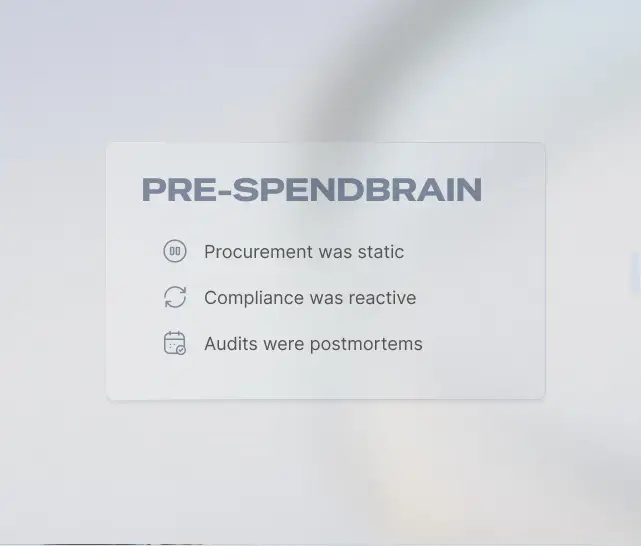
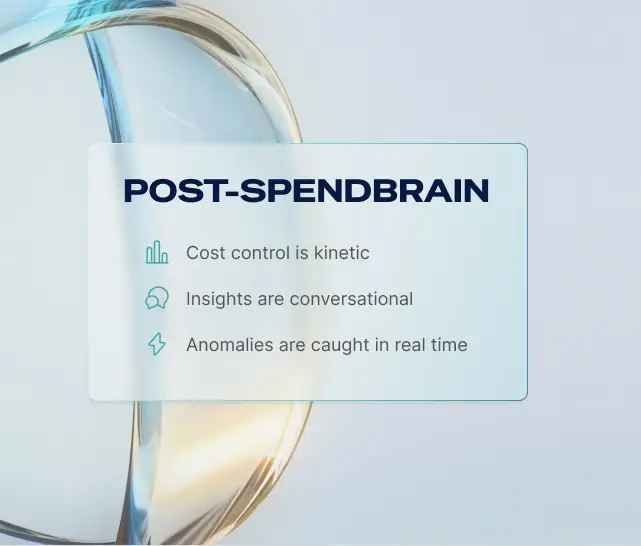
As for the vendors, they would prefer you to stay in a fog. Their pricing models are tiered, gamified, and, dare we say, intentionally confusing. Traditional P2P tools help execute their opacity while SpendBrain calls them on their bluff. Beyond asking if next month’s invoice amount is correct, SpendBrain asks whether you should be paying it at all.
Why Now?
For too long, businesses have handed over their operational data to tech platforms that monetize it for their own gain. By investing in a Spend Ontology, you’re turning the tables and building your own financial intelligence layer, one that delivers ongoing savings, institutional memory, and the kind of competitive edge your vendors hope you never develop.
This isn’t about digitizing paperwork. It’s about turning spend data into strategic power.
Because in the “spend-more” world, the smartest companies are the ones that question everything.
It’s time to build your own ontology and finally have a conversation with your spend.