Bill Pay Models Compared: Legacy Providers vs. Tech-Forward Solutions
Businesses choose how to pay bills from a handful of models, not a single product type. Some outsource the whole job to a processor that receives, audits, and pays invoices. Others automate accounts payable in software. A newer group adds spend intelligence on top of payment. Each model fits a different situation.
This guide describes the main models, names representative providers, and lays out the benefits and tradeoffs of each. It is not a ranking. The right choice depends on invoice mix, volume, systems, and how much oversight you want over what you pay.
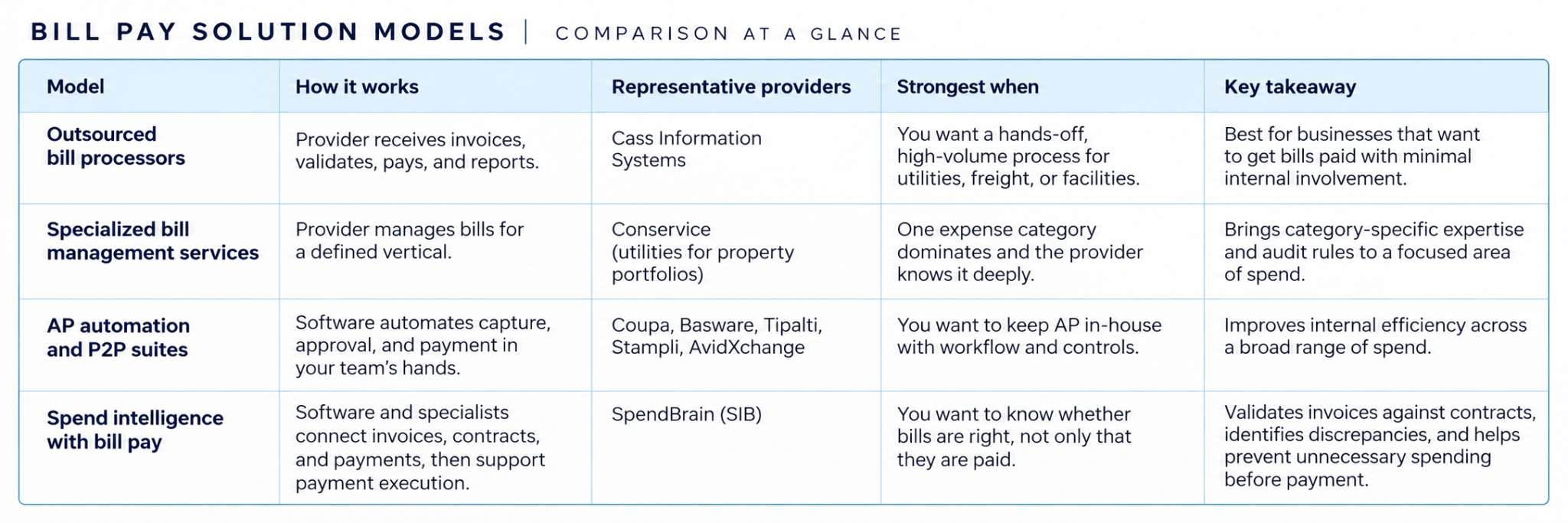
The four models at a glance
- Outsourced bill processors: Providers receive, validate, pay, and report on invoices. Companies like Cass Information Systems are a strong fit for businesses seeking hands-off, high-volume bill processing for utilities, freight, or facilities.
- Specialized bill management services: Providers manage billing for specific expense categories or industries. Solutions like Conservice, which focuses on utility management for property portfolios, work best when one expense category dominates and specialized expertise is important.
- AP automation and procure-to-pay (P2P) suites: Platforms such as Coupa, Basware, Tipalti, Stampli, and AvidXchange automate invoice capture, approvals, and payments while keeping AP operations in-house. They're best suited for businesses that want greater workflow efficiency and control.
- Spend intelligence with bill pay: Solutions like SpendBrain from SIB combine software and specialist expertise to connect invoices, contracts, and payments. This model is strongest for businesses that want to validate whether charges match negotiated terms, identify billing discrepancies, and prevent cost leakage, rather than simply ensuring invoices get paid.
Model 1: Outsourced bill processors
What it is. A provider takes over the invoice-to-payment cycle. Cass Information Systems is the best-known example. It receives invoices through EDI, web retrieval, and OCR, validates them, contacts vendors when invoices are late, pays them, and reports on the data. Cass says it manages about $20 billion in annual facility-related spend and covers more than 150 service types, including natural gas, water, electric, waste, and contract maintenance. It also provides freight audit and payment, and owns a commercial bank that supports its payment operations.
Benefits
- Removes most manual invoice handling from your team
- Mature processes built for very large volumes
- Funds movement handled by a bank-owned processor
- Consolidated reporting across facilities
Tradeoffs
- Designed mainly for large enterprises with high volumes
- Strength is in specific categories such as freight and facilities
- Validation is oriented to audit rules and rates on file, and may not follow every contract term in your wider vendor base
Model 2: Specialized bill management services
What it is. A provider manages bills in one vertical. Conservice, for example, obtains, audits, and pays utility invoices for multifamily and similar portfolios. Its published offering includes invoice retrieval, a 20-point audit, trend and abnormality identification, error resolution, and payment with multiple funding options.
Benefits
- Deep expertise in one expense type
- Added services such as budgeting, vacancy identification, and sustainability reporting
- Clear fit for portfolios with repetitive, similar bills
Tradeoffs
- Narrow scope outside the core vertical
- Another vendor to manage if you also have non-utility vendors
Model 3: AP automation and P2P suites
What it is. Software that automates invoice capture, coding, approvals, matching, and payment, and in P2P suites extends upstream into purchasing and sourcing. Gartner named Basware, Coupa, Esker, and Medius as Leaders in its 2025 Magic Quadrant for Accounts Payable Applications. Tipalti is common for global payables, and Stampli and AvidXchange for mid-market AP teams.
Benefits
- Your team keeps control of workflow and approvals
- Strong ERP integrations and approval routing
- Faster cycle times and fewer manual keying errors
- P2P suites tie purchasing, receiving, and payment together
Tradeoffs
- Validation centers on PO matching and coding, and usually does not check billed rates against contract terms
- Implementation effort varies, and analyst reviews note longer timelines for some enterprise suites
- Your team still handles vendor setup, exceptions, and follow-up
Model 4: Spend intelligence with bill pay
What it is. A connected layer that combines AP automation, contract intelligence, invoice auditing, and payment, so the same system that pays a bill also checks it. SpendBrain from SIB is an example. It connects invoices, contracts, vendors, approvals, payments, purchases, and spend history into a spend ontology, and validates invoices against contract terms. It is designed to work alongside an existing ERP or accounting system, which remains the system of record.
SIB pairs the software with hands-on Bill Pay support. Its implementation team contacts vendors to establish efficient invoice-delivery and payment methods, a dedicated Bill Pay Operations Specialist guides implementation, and approved payments can be disbursed by ACH, purchasing card, or check. SIB category specialists review anomalies and pricing opportunities that the software flags before any action is taken.
Benefits
- Invoices are checked against contract terms before payment
- Anomalies, renewals, price increases, and underused contracts surface in one place
- Specialists handle vendor outreach and validate findings
- Spend data supports procurement, accounting, and executive decisions beyond AP
Tradeoffs
- Value is greatest when contracts and recurring services spend are significant
- Teams that only need basic payment execution may not need the added layer
How the models differ on what matters
How to choose
- Bills are repetitive and high volume, and you want them off your desk: an outsourced processor or specialized service.
- You want your team to own AP, with better workflow: an AP automation or P2P suite.
- You suspect you are paying more than contracts allow, or want visibility across vendors: a spend intelligence platform with bill pay support.
- A mix of the above: many companies pair a payment model with a validation layer.
Questions to ask any provider
- Who contacts vendors to set up delivery and payment methods?
- Are invoices compared to contract terms or only to rate tables and POs?
- Which payment methods are supported, and who holds the funds during processing?
- How are late invoices and disputes handled?
- What does implementation involve, and how long does it take?
- Does the provider replace or work with your ERP?
Frequently asked questions
What is bill pay for businesses?
Business bill pay is the process of receiving, approving, and paying vendor invoices. It can be run in-house with software, outsourced to a processor, or supported by a hybrid of software and specialists.
Is bill pay the same as AP automation? AP automation covers the broader invoice workflow of capture, coding, approval, and payment. Bill pay is the payment and vendor-management portion, and some providers offer it as a service.
Can I add contract validation to an existing AP process? Yes. Tools like SpendBrain are designed to work alongside an ERP or accounting system rather than replace it.
Provider details are drawn from public vendor pages, filings, and analyst reviews and may change. Confirm current offerings with each provider.
The Bottom Line: Paying Bills Is Only Half the Equation
The right solution depends on what your business needs to accomplish. Outsourced processors reduce administrative work. AP automation platforms improve internal efficiency. Specialized providers bring expertise to particular expense categories.
But there's an important distinction between paying invoices efficiently and making sure you're paying the right amount in the first place.
For businesses managing significant recurring expenses across vendors, locations, and service categories, that distinction can have a direct impact on profitability.
SpendBrain brings these capabilities together, combining managed bill pay with contract intelligence, automated invoice validation, anomaly detection, and hands-on specialist support. Instead of simply processing invoices, your organization can identify incorrect charges, monitor contract compliance, and uncover opportunities to reduce costs continuously.
Connect with OUR TEAM
We look forward to hearing from you